DAY NINE
[Feb. 19, 2015]
After breakfast, a van picks us up for the three-hour drive
to the lagoon. Out of town, up and over
the Sierra Gigante – the mountains that run down the spine of the southern part
of Baja. These are magnificent
mountains, high desert pinnacles laced with deep arroyos – and actually a very
nice paved two-lane highway that winds like a ribbon. (Julio, our van driver, is the most polite
and attentive young man, and drives with such care around each winding
precipice, that none of us are white-knuckled, that I’m aware of.)
Once through the mountains, the road continues across a
broad western desert plateau.
We stop
for a small herd of goats crossing the road, being all successfully corralled
by a bright-looking, long-legged yellow dog, circling and nipping at their
heels until they are all safely across, and then the dog deftly herds them
along the roadside.
We couldn’t see a human
goat-tender anywhere around, but assumed they were close by in the scrub.
At another lonely place, there were two
ranchers trotting along the roadside, bareback, on burros, the broad brims of
their straw hats bouncing up and down with each clop-clop.
We couldn’t see any structures nearby, or dirt
roads or fences, but it sure seems they had a destination in mind.
We know we are nearing the Pacific coast when Sarah, our
naturalist, points out the osprey platforms, one every quarter mile.
They are built to provide the osprey an
alternative to nesting atop the electric poles that line the roadway.
Just about every platform is in use – large,
messy stick nests plainly visible, as are the great birds themselves.
I also spy two crested caracaras foraging in
a ravine along the roadside as we pass by.
We arrived at the crowded little village of San Carlos on
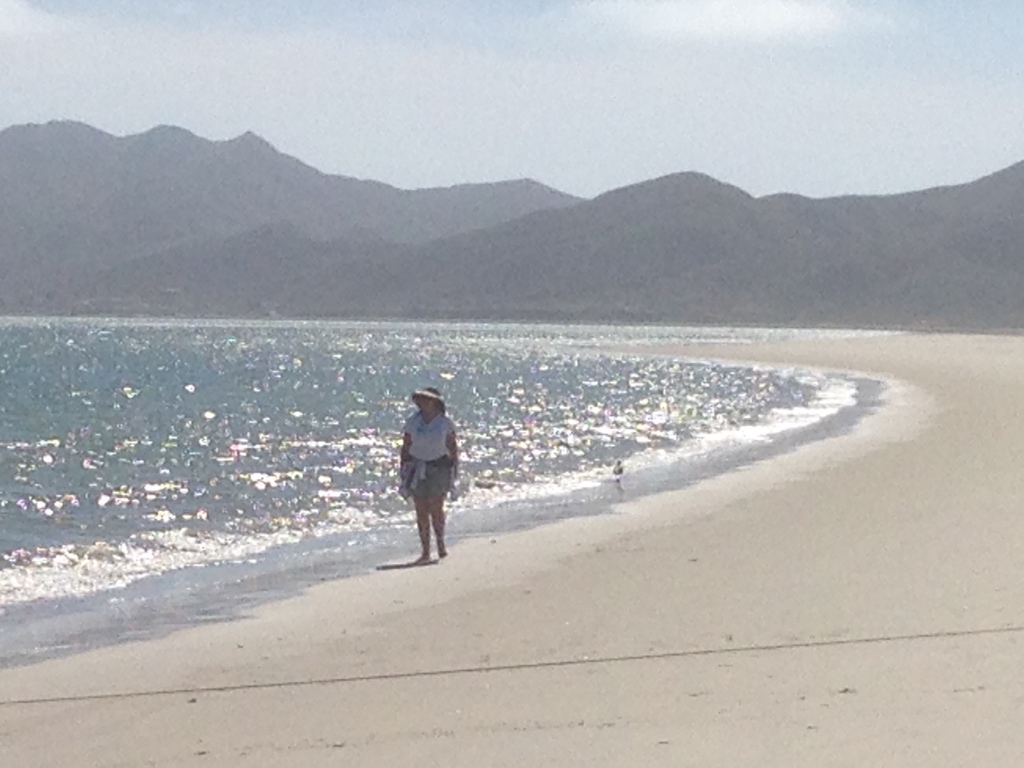
Bahia Magdalena, and proceeded to a white sand strip of beach at the far edge
of town. Here a panga boat was waiting
to take us out to the whale camp. We
were met by Roman, a friendly, happy, smart guy who immediately took charge of
our group, and who also happened to be Julio’s uncle. With great efficiency, he had our van
unloaded, had us each outfitted with life vests, and had our belongings transferred
to the panga as he invited us to wade out and climb into the boat. We each had our water shoes on, shorts or
pants rolled up, and a wind-breaker/rain jacket, as per instructions. It was like stepping into bath water, shin
deep, and we boarded by swinging a leg over the side and clambering in. Ran and I both sat in the bow.
A panga is basically a 25’ fishing skiff with an outboard
motor and 3 or 4 benches spanning the width.
This one had a center driving console and a sunshade canopy over the
benches, for which I was grateful as it was a bright, sunny day. Our 20-minute ride would be a wet and wild
one, bouncing hard across the bay at 35 knots, taking us to Isla Magdalena (the
island), where we were to camp for the night.
Bahia Magdalena is a large bay, about 20 by 30 miles, formed
by the long, narrow, “L”-shaped island that separates the shallow bay from the
Pacific Ocean. This is one of only a few
places in the world where gray whales migrate to mate and to give birth. In fact, according to our guide Roman, a
well-versed whale educator as well as outfitter, all gray whales are
Mexican! The only existing group of
these whales in the world travel only along the Pacific coast of America,
summering and feeding in the deep, rich waters of the Bering Sea. They migrate south to winter along the Baja
coast, where the large shallow bays provide protection and warm water for
breeding. During this time, they relay
on their stored fat, which must sustain them until they head north in the
spring, to feed again.
Our camp on the barrier island of Magdalena was along the
narrowest part of the island, just a half-mile over the dune to the ocean side,
which made a nice exploration walk.
It
is the only permitted camp on the island. White walled tents were arranged on
the sweeping white sand beach, everything tidy and sparkling in the sun.
There was an open galley tent and a dining
tent.
And down a short path, a very
decent privy tent.
Roman’s crew couldn’t have been finer. They were 5 young men, earnest, capable and
delightful: a second naturalist, a
professional chef, two boat capitans, and one general worker. After a yummy lunch of yellow-fin tuna salad
on tortillas, we suited up again for the panga ride out to the whale watching
area at the far end of the bay, where the mothers were nursing their weeks-old
calves.
It was the most indescribable, exhilarating, mind-bending
afternoon, making friends with these giants of the sea.
Without a doubt, they seemed to enjoy the
interaction, seeking it out, always coming back for a closer look.
They seemed as curious about us as we were
with them.
We hung out with one young
mother and her baby, and she seemed to nudge and encourage her little one to
come and play. I thought it had been fairly amazing to look a dolphin in the
eye, but over and over again the mother would propel her massive head out of
the water and take a good, long look.
Astounding feeling! And then there were those fortunate enough to be sitting in
the right spot when she would come up alongside as close as she could get, and
those lucky folks could reach down and gently stroke her snout or her
back.
Or when she would come up suddenly
with a loud exhale, forcefully propelling her copious spray all over whoever
was nearest, just another way to say ‘hello’ I think.
She was easily twice as big as our boat, one
committed bump from her would have meant big trouble for us – but she always
knew where her elbows were, and was very gentle.
(Three weeks later, at another bay, St. Ignacio, we had a
similar encounter with another friendly whale dubbed “La Cee”, due to a pattern
of barnacles on her side in the shape of the letter C.
She stayed alongside us for a solid 40
minutes, at times gently bumping the boat from the side or from beneath, trying
to roll over enough to get a good look, and finally managing to stay in the
current enough to let us all stroke, pet, and even kiss her!
How surprisingly delicate and soft is her
skin, and cool to the touch.)
After the exhilarating afternoon, we dined on fresh grilled
lobster tail (the workers had gone diving for them while we were out whale
watching) and after a stunning sunset, watched an entertaining and educational
slide show on gray whales. I learned
that their mating is very cooperative, rather than competitive as it is with
most mammals. It takes at least two
males to mate with one female as one must support and balance the mating pair.