Monday, July 2, 2018

Loreto Town - Day 8

DAY EIGHT
[Feb. 9, 2015]

With time for Tracie to do her last minute provisioning and Bill to finish painting in crew world, Randy and I are tasked with accompanying the incoming guests on a two-day trip to the Pacific coast, to visit the whale birthing lagoons.  The group of 5 guests arrive mid-afternoon at the Loreto airport and settle into rooms at a very nice colonial Spanish-style hotel in the middle of the old downtown.  We are welcomed into a small, bricked courtyard decorated with many varieties of potted palms and cactus, and guests are led to their rooms through arched, open air passageways overhung with flowering tropical plants.  Loreto is the oldest mission settlement in the Californias, founded by Jesuit missionaries in 1697, now a charming town that steps you back in time. 


The old stone church, Mision de Nuestra Senora de Loreto, is the centerpiece, and the adjacent main cobblestone town square is set off with topiary archways along narrow pedestrian side streets lined with tidy, colorful boutiques, galleries and cafes.  After we spend the afternoon wandering this lovely town, the guests meet Captain Bill and Chef Tracie for an introduction dinner at Papagayos, an open air restaurant with tables set among intimate gardens canopied with various palm and fruit trees, all draped in colorful lights.  Coconut Crusted Shrimp, Chocolate Clams tempura and artichoke goat cheese salad = delicioso!


Wow, I manage to find a few bars of wifi coverage at our hotel; how strange it seems to connect to the big, wide world.


Puerto Escondido - Day 7

DAY SEVEN
[Feb. 8, 2015]

Today is our last day of quiet, “private” yachting in the wilderness.  We are making our way into port today, near Loreto, where Sarah, our naturalist, will join us in preparation for the arrival of guests.  After breakfast, Randy invites me down to the engine room to watch him start the engine.  This is a major event.  The process takes about 20 minutes. 

The engine room is as large as a huge kitchen; every wall surface covered with gauges, dials, hoses, wiring, levers, switches, and there is the gleaming dark green and bronze engine, the size of a Volkswagen bus, bolted in the center.  This is the original 1923 Atlas Imperial engine, the oldest operating one in existence.  The boat was literally built around it.  Replacement parts have to be custom made.

Randy escorts me to a door hidden along the starboard passageway, and we descend a steep, black iron ladder into the belly of the ship.

Part of Randy’s job includes manually oiling all 134 exposed moving parts, every three hours during operation, plus eight grease points, maintain the levels in five drip oil canisters, and keep a vigilant eye on all valves, pressures, temperatures and levels.  I guess that’s what we have computers for in modern engines today. 

When everything is lubed, primed, positioned and ready to go, he grabs the big 40 lb. iron bar and manually rotates the giant fly wheel into position; adjusts pressures, gives the engine a shot of compressed air, and the mighty pistons jump to life – sounding bogota, bogota, bogota -  the heartbeat of the boat, pumping in rhythm once again.

If all is well in the engine room, Randy goes topside to haul the immense anchor, which has its own long listed procedure.  Then, Captain sets the course, and we are off to sea.

There is a glimmering line ahead in the water, silver flashes in the sunlight.  It is a pod of common dolphins, smaller than the bottlenose, about a mile distant.  As we approach we can see them gaily dancing through the water, literally hundreds of them, their sleek wet backs rounding up and then down again, going in every direction.  Several veer away from the group and make a beeline in our direction, to play in the bow waves for a few minutes before re-joining the group as we pass on by.

This is deep water in this part of the gulf, perhaps 700 feet.  A perfect spot for a great blue whale, the largest creature ever known to inhabit the planet.  An adult can be as big as three city buses, their tongues alone can weigh as much as an elephant. Their hearts, as much as an automobile.  These whales dive deep to feed on shrimp-like krill (up to 4 tons per day), and they come to the warmer waters of the gulf of Mexico for winter breeding.  Sure enough, before too long, Bill spots a misty spout in the distance.  These 100-foot long mammals can exhale a spume up to 30 feet high.  As we close the miles, we see that there are two whales, most likely a mother and calf traveling together.  We idle at a safe distance, and watch them for several minutes.  First, the mighty blow; then, slowly, the broad glistening back appears smoothly above the surface, and keeps going, and going; then the distinctive dorsal fin; then, finally the powerful flukes emerge, and keep rising, and rising – massive flukes the size of an airstream trailer, we see clearly the gentle blue-gray color and water dripping from the edges back into the sea.  Without a sound they slide under the surface, and the whale is gone.
Rare Glimpse of a Great Blue Whale Sounding

It is a long, pleasant day of sailing north, turning into Puerto Escondido about 4 pm.  This is the closest protected marina to the town of Loreto, about 30 minutes away, where we will pick up our guests at the airport day after tomorrow.  I see a committee of vultures soaring lazily over the cactus-studded hills that gird the marina, and a lone frigatebird perched atop a large rock near the shore.  A great blue heron watches us from the marina dock. 

We are moored in the center of this broad blue harbor, which is surrounded by high desert hills and dotted with many white boats on scattered moorings.  This marina is still recovering from the massive hurricane five months earlier – there is a boatyard full of recovered, broken and uninsured vessels.  I see the skeleton of a small boat tossed high up among the cactus – and a bulldozer is hard at work near the new marina office.


As Tracie cooks dinner, I watch a blue-footed booby hunting along the shoreline. She flies low over the water, then dives in head first, covering several feet under water before she comes up sputtering, and takes to the air again.  I watch her do this six or seven times in one direction, then circle around and return, doing the same glide, dive, sputter, glide, all the way back to her starting place.  I watch her do this, up and down the shoreline, for about 20 minutes.  Either she’s a very bad fisherman, or she’s getting a very big belly full.  Eventually she circles higher, and flies off out of sight around the last hill.


El Pardito: Fishing Village - Day 6

DAY SIX
[Feb. 7, 2015

A quiet, calm night, with brilliant white stars in a black cloudless sky.  Never have I seen so many stars!  And a quiet, calm morning, the early moon like a soft bubble in the sky.  With the low angle of the morning sun, the hills glow neon red.  We make an early start today, hoping to make the longest passage while the weather is so calm.  There is one stop along the way – tiny Isla Coyote – a mound of brown rock with a cliff face to the south, gently sloping down to the small shore, and a surprising cluster of bleached square buildings tucked and layered into the hillside, reminding me of a classic Mediterranean coastal village.  There is what looks like a Spanish mission chapel nestled at the very top of the hill, classic twin square towers straddling a small arched entry, maybe a comfort for this quaint, isolated fishing village.


I can make out three long sheds along the beach, with thatched roofs, and I can see two white dories pulled up on the rocky shore, which is also dotted with colorful spots of yellow and orange.  I realize these are the fishermen, in their bright, suspended, rubber trousers.  They are pulling in the nets from the boats, gathering in a plentiful morning’s catch, and sorting fish into a collection of large buckets and tubs.  This accounts for the abundance of raucous sea gulls noisily covering that end of the island.

This little fishing village is named El Pardito – “little brown island” – and is currently inhabited by perhaps twenty individuals.  Alberto and Rosalita moved their young family to this rock in 1923, getting away from the noise and bugginess of LaPaz, to this quiet spot where they could enjoy life to themselves and the soft sea breezes. 


They subsist on what comes from the sea, plus three small pineapple plants struggling to survive in a small plot of dirt.  They raised their family of five children here, built homes into the hillsides, including a small schoolhouse, and the chapel, when their sixth child died in infancy because they couldn’t get to a doctor. Other fishermen have come and stayed for a time, some of the children moved back to the mainland, and the schoolhouse now stands empty. 


Those still living here know that they may be the final generation, but it seems such a tranquil place, and a kind and happy way to live, that as long as fish fill the Sea of Cortez, this rock may stay inhabited.  There are many such villages along the shore, but this was the only island village we saw.

Bill drops anchor here and soon a skiff pulls away from the island and heads our way, loaded with over a dozen 8-gallon blue plastic drums.  Me llamo Pablo,” our guest grins up at me as I stand at the rail of the Westward.  He is a short, very brown-skinned man with friendly dark eyes and a wide-brimmed straw hat.  He is barefoot and his gray polyester pants are rolled up to just below the knee.  He nimbly steps from thwart to thwart of his small white boat, rocking in the waves, while he passes up a rope to be tied off.  Mucho gusto, soy Carolina,” I manage in return.  Tengo mucho agua por usted, says Bill, “Gusto
usted agua dulce?  “We have lots of fresh water for you. Would you like a coke while we fill the jugs?”

One of the reasons these islands are not populated with humans is the lack of fresh water.  There just is no source.  This little fishing village relies on water skiffed in from the mainland.  Randy, as engineer, has been making water all morning.  The ship’s supply of fresh water comes from an on-board desalinization process, making pure water from the salt sea through reverse osmosis.  With a 1000-gallon water tank, we have plenty to share.  This has become a regular stop on the Westward’s north/south passage, bringing fresh water to this tiny village in exchange for fresh fish.  The guests, too, are invited to come ashore and visit this remarkable place and see their fishing operation.  A daughter, Cordelia, has beautiful jewelry for sale on her shady thatched and tiled terrace; she makes these herself from local shells and beads.

With his water drums filled to the brim, Pablo offers many muchos gracias, and returns with a sack of fresh trigger-fish from the morning’s catch.  We toss him several coca-colas in return, and we will have Tracie’s amazing ceviche tacos for supper tonight.  We’ll see Pablo again next week, on our trip back south.

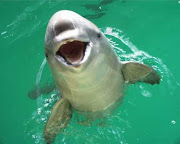
Once underway, ahead, off the bow, I see a fin cut the water and disappear.  Then again, heading straight toward the boat.  Soon, two bottlenose dolphin are swimming at the bow, one on each side.  I can look straight down into the deep green water and see clearly their sleek gray bodies – quite big! – purely enjoying the ride.  Each of them in turn roll to the side as they go, and look right up at me with a bright round eye.  Amazing experience, out in the wild, making eye contact with a dolphin swimming intentionally alongside, there under the clear green water.

After a long day of progress north in open water – though it seemed to me we spent as much time moving up, and then down again, as we did actually moving forward – we tucked in for the night behind Punto Marcial (Marcial Point), in Bahia Berrendo on the peninsula.  This seems a much wilder place than the island bays, as high, jagged cliffs come down from the interior mountains to meet the sea. 
I see a long, low cave at low tide,right at the water's edge.  A large, white-topped boulder looks like it has just been rolled away from the entrance.  Interesting rock formation, I thought, half quartz -- that's odd. Then I saw the pelicans.  And this, apparently, was their favorite roost: ah, pelican guano. Many, many pelicans.  Resting, rafting, floating on the wind like a tiny platoon of hang gliders.  Until one suddenly stops flying, and drops out of the sky - dive bombs kerplop! --into the water with a big splash -- and then lifts off again, joining the others in the aerial survey.  A full pouch of supper, no doubt.

This bay is wilder, cut into the mountains, and it is a shallower bay, too, protected from the sea by only a slight jut of land.  Most of the deeper inlets are surrounded on three sides.  This protected exposure makes for a gentle roll all night long, like sleeping in a constantly rocking hammock.


Los Islotes & Isla San Francisco - Day 5

DAY FIVE
[Feb 6, 2015]


 I just learned this morning that the Baja peninsula is the second longest peninsula on earth and the Sea of Cortez (named after the Spaniard Hernan Cortes, conqueror of central Mexico in the 1530s) offers one of the largest island archipelagos in the world.  Including all the smallest rocky islets there are nearly 1000 islands stretching along the 800-mile length of the Gulf of California.  Most of these islands are designated as a Mexican wilderness preserve and a UNESCO World Heritage Site.  Scientists have referred to this region as the ‘Galapagos of Mexico’, as the Sea of Cortez hosts the largest number of endemic plant and animal species in North America.  It also harbors extensive remnants of the pre-historic Pericu people, aboriginal inhabitants of the southern coast of Baja, sketchily described by early European explorers and missionaries, and considered extinct by the late 1700s. 


At nearly every anchorage where we tucked in for the night, we could see natural caves high up on the headland cliffs, some apparently containing well-documented shell and flint-tool middens, red ochre hand prints and other cave art, and occasionally, a pre-historic burial cave.

(One of our naturalists said he did once find an ancient skull while exploring a nearly inaccessible cave high up on a ridge.  He alerted the National Mexican Archaeological Assn.)


Near the north end of Espiritu Sancto is a tall outcrop of jagged rock, separated from the main island by a mere half mile.  It is called Los Islotes (The Islets) and from a distance, I thought these craggy rocks looked like white marble, resembling a Disney castle.  But as we drew nearer, the first thing I became aware of was a noise like a herd of pigs, and then I realized the rocks weren’t white at all, but dark rocks covered in guano. Then suddenly, it seemed the rocks were moving!  Large brown lumps, bobbing and swaying. This is a Sea Lion haul-out.

The sausage-shaped sea lions are draping every possible ledge (however did they get UP so high!), piled on top of each other, some of the juveniles cavorting in the choppy water, and every one of them barking with gusto.  One particularly large chocolate-colored male, fully mustachioed and muscular, stretches his long neck, bobbing back and forth, his head held high.  He is towering over his indifferent harem, intent on intimidating us with his powerful roar.  Then, with one graceful push of his massive hind-end, he glides into the water and disappears.  We slowly circle the islets, fascinated with the intensity and cacophony of this mountain of life. 
Blue-footed Boobies courtship dance
Brown pelicans are everywhere, swimming, diving, preening;  and blue-footed boobies are nesting high on the uppermost ledges.  I notice one in particular, highlighted against a patch of guano, and I can distinctly make out her neon blue webbed feet.

We pull into a quiet bay at the southern tip of the next island, Isla San Francisco.  Well protected from the breezes coming down from the north, Cap Bill decides to stay put for the day while we are so calm and still, and make progress on the work going on down in the fo’c’stle. 
Bill and Randy are re-outfitting the crew’s quarters, doing finish carpentry as well as fiber-glassing the new shower and re-laying the floor of the head (bathroom).  It would be nice to not have the boat rocking and rolling and bounding along as they work below in the bow.

This week without guests has turned out in many ways to be a blessing – giving Bill and the hard-working crew a chance to slow down the pace and accomplish many projects that needed attention.  I’m learning routines of cleaning and service (cleaned all heads this morning J) and picking up tips as I hang out with Tracie in the galley.  For instance, I didn’t know you could make sausage from left-over bits of chicken meat (and then we had delightfully messy sautéed peppers and onions with sweet Italian chicken-sausage patties served on fresh-baked spelt rolls for lunch today) or use the fat from galley-butchered rump sirloin to make your own noodles for out of this world stroganoff (dinner last night).  Earlier, the galley smelled like heaven (I’m sure of it) as Tracie fresh-ground her spices from the bulk storage: cinnamon, cumin, nutmeg, oregano, cardamom, anise….

The sparkling water here in this bay is more green than blue, and the surrounding landscape is a band of low, red, rounded hills, like a ring of sleeping dromedaries.  I can see across to the mainland; the headlands there remind me of the Grand Canyon.  Horizontal cliff bands of emerald, umber, magenta, plum –depending on the mineral content of each layer – rise up from the green sea in a colorful escarpment.  This exposed geology tells a dramatic story, if only I knew how to read it.

The bay is dotted with about half a dozen other boats at anchor, the most we’ve seen so far – mostly sailboats, one small pleasure yacht, and one beautiful, sleek, old wooden schooner.  This is the ‘Martha’, a sail-training vessel from Pt. Townsend, WA, USA, familiar to Captain Bill from his home waters.  Randy enjoyed going aboard her when he was in Washington a year ago, doing carpentry for Bill on the Westward while in dry dock there.

In this quiet harbor, I see my first of many Mobula Rays – square pancakes, maybe 2 to 3 feet across – that POP out of the water and plop back, often several times in a row – plop!  plop!  plop!  Sometimes there are so many it sounds like popcorn!  And they also delight with their aerial acrobatics, somersaults, flips, 360s.   When they’re just cruising around, you can identify them by the two parallel little fins, dark on the top side, silver underneath, opposite corners of their square bodies, like little twin sails out of the water.  Nobody seems to know why they do what they do.
After chores, I spent the afternoon idly reading and writing, enjoying the cloudless blue sky and gentle warm breeze.  Until Tracie suggested we all take a little break and go explore along the short, white beach.  She packed a cooler bag with a tin of mixed nuts and makings for “beach juice”, and after we landed the skiff and secured the mooring rope with several large rocks, Tracie pulled out paper cups, a bottle of crushed ice, another bottle of fresh-squeezed orange juice, and yet another bottle of vodka. 
We mixed our drinks and lingered on the white sand for a bit, and then Tracie and I took off on a little trail through the scrub, over a small rise to go to a beach on the other side of the island.  This new beach was strewn with rounded bright pebbles of every color – and we went agate searching.  We didn’t find any agates, but interesting bits of sea shell and coral, and one small chunk of veined olivite. 

Among some large rocks at the edge of a protected little backwash, I saw my first Sally Lightfoot crab, which I had just been reading about.  These are quick, pointy, shiny red crabs, named after an exotic Latin American dancer who liked to wear high heels and sequined red gowns.  I can see why, as she skitters away on her dainty little legs! 


The sun was getting low as we skiffed back to the Westward, stopping by to chat with old friends on the Martha as we motored past, and then home for a supper of smoked marlin tacos and the next episode of Horatio Hornblower.